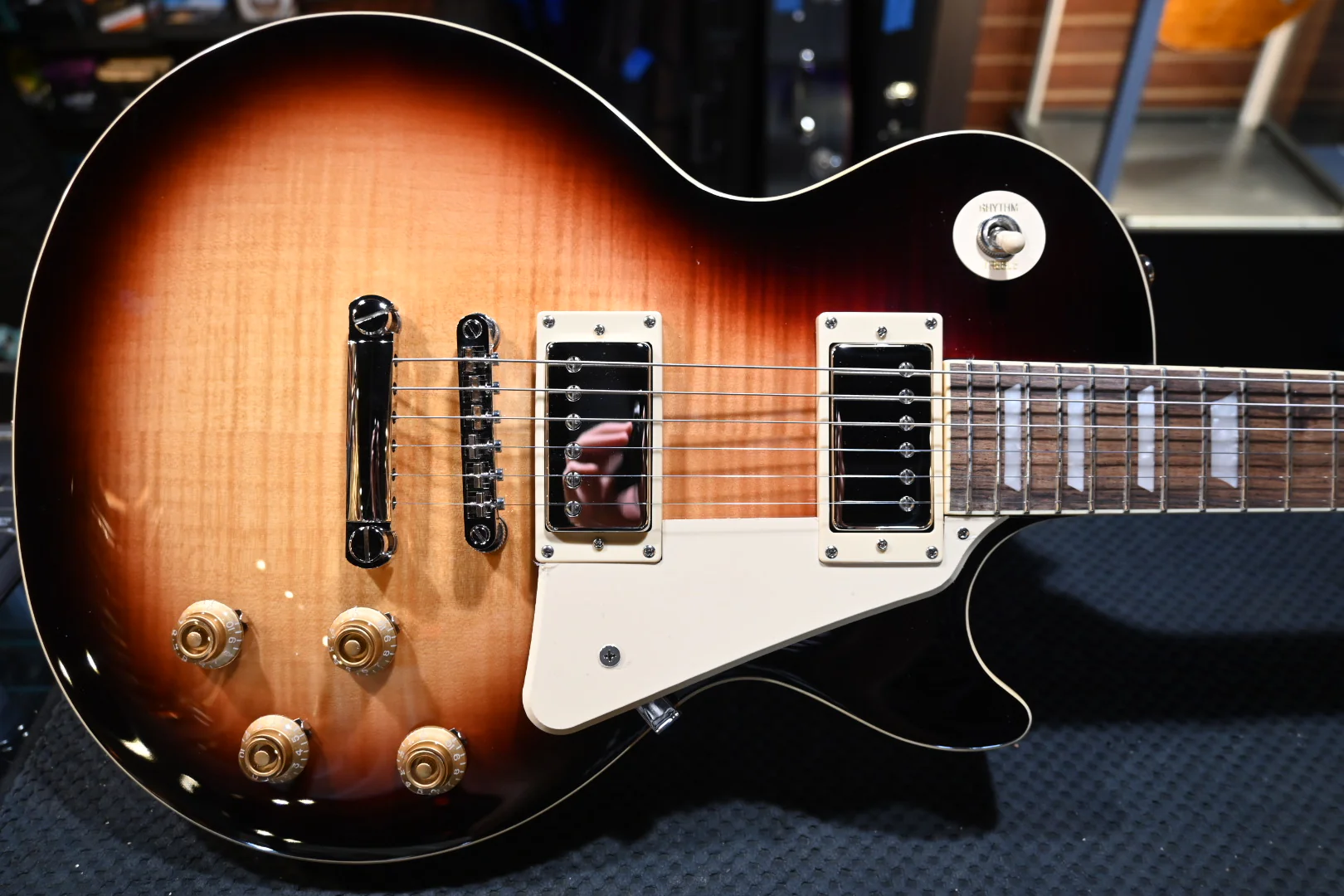
Six months after Priya N. won an Alpine White Epiphone Les Paul Custom from our platform, she sent us a follow-up photo. The guitar was on a stand in her living room. There were pick scratches around the bridge that hadn't been there when it shipped. The gold hardware had started to develop fingerprint patina. She had played it.
Twelve months after the original win, she sent a second photo. Same guitar, same stand, more wear.
Of every guitar we've given away, the Epiphone Les Paul Custom is the one we get the most follow-up photos of. We've thought about why for a long time. This article is what we've come up with.
The myth
For a stretch of the 90s and early 2000s, Epiphone existed as a brand-loyalty test. You bought one because you couldn't afford a Gibson. The implication was that the Epi was a stepping stone, and any serious player would eventually upgrade.
That framing did real damage. It took Epiphone two decades to recover from it, and even now, certain corners of the guitar internet treat owning an Epiphone Les Paul as a statement about your budget rather than your taste.
What the spec sheet says
The current Epiphone Les Paul Custom uses a multi-piece mahogany body (most current Gibson Customs do too), a maple top with multi-ply binding, an ebony fretboard, and Alnico-magnet humbuckers. Gold hardware. Five-piece body and headstock binding. Original hardshell case with the Epiphone logo embossed on the lid.
None of that makes it a Gibson. The Gibson uses tighter tolerances on the neck pocket, slightly higher-grade tonewoods, and pickups that are wound to slightly tighter specifications. The differences are real. The differences are also a lot smaller than the price gap suggests.
The follow-up photos
We've given away seventeen Epiphone Les Paul Customs over the past three years. Fourteen winners sent us a “first day” photo. Twelve sent at least one follow-up photo, ranging from three months to two years after the win.
The follow-ups all look weirdly similar. The guitar is on a stand in a living room. The bridge has pick scratches. The gold hardware shows wear. Sometimes there's a buckle scuff on the back. Nobody is posing. The guitar isn't being staged. It's just sitting there, used hard, photographed casually.
The pattern says something about the instrument that the spec sheet doesn't capture.
What the spec sheet can't tell you
The Epiphone Les Paul Custom is a 9-pound guitar. That's heavy by modern standards, and the weight matters more than you'd expect on hour-three of a session. The neck is a thick 60s rounded profile, which not every player will get along with. The gold hardware tarnishes faster than most owners expect, especially in humid climates.
These are real trade-offs. They're also the trade-offs Les Paul players have been making since 1957. Players who like Les Pauls accept the trade-offs. Players who don't, don't. Either way, the Custom isn't trying to be something it isn't.
What's in this draw
Alpine White finish. Original case, hangtags, factory set-up paperwork. Our luthier has checked the fret level, set the truss rod, and verified the pickup wiring. The unit is set up to play.
If past patterns hold, whoever wins this guitar will be the type to send us a follow-up photo a year from now showing exactly how much they've played it.
The active draw
The Epiphone Les Paul Custom is currently featured in an active Great Guitar Giveaway draw. Entry tiers, pool size, and close date are on the draw page. Past winners across all our draws are catalogued on the past winners page.