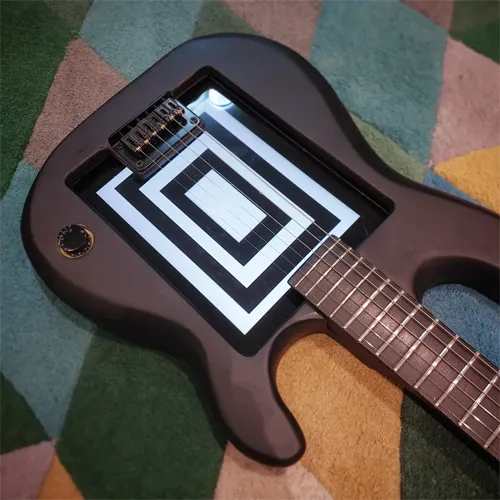
A working iPad lives inside a Telecaster. The first time you see one in person, your brain refuses to process it for about four seconds. After that, you start asking the right questions.
The iCaster is the work of Daniel Wallis, an independent luthier operating under the Devil and Sons banner. He's built three of them. The one currently up for grabs in our active draw is build number two — original case, original documentation, certificate of authenticity. We've handled it. It plays. It works.
This article is for the people whose first reaction was skepticism. We were too.
What the iCaster actually is
It's a Telecaster. A real one. Alder body, roasted maple neck, vintage-spec '64 Tele bridge, hand-wound pickups, nitro finish. If you ignore the iPad, you're looking at a guitar that would land favorably in any boutique-shop comparison.
The iPad is wired into the body so the guitar's audio output runs through it. Switch the iPad off and the guitar reverts to a standard passive Telecaster. Switch the iPad on and you can run any iOS audio app — modeling amps, looper, multi-effect, full DAW. The screen sits flush under the pickguard. The implementation is unbelievably tidy.
Why it isn't a gimmick
A gimmick is something added on top of an instrument that compromises how the instrument plays. The iCaster doesn't compromise anything. The iPad sits in space that would otherwise be hollow. The guitar's weight, balance, neck angle, and pickup placement are unchanged from a standard Tele. You can play it with the iPad off and have a great guitar. You can play it with the iPad on and have something nobody else has.
That's not a gimmick. That's a thesis.
The thesis Wallis is making
Most modern guitar innovation is incremental. Slightly better pickups. Slightly newer scale length. Slightly different finishes. The iCaster is the rare instrument that makes a categorical claim — that the guitar as we know it can absorb a modern computing device without losing what makes it a guitar.
If you accept the claim, the iCaster is one of the more interesting guitars built this decade. If you reject it, you're at least forced to articulate why. Either way, you're thinking about guitar design in a way you weren't before you saw it.
What the press got mostly right
Creative Bloq covered it as a curiosity. iMore covered it as an iPad accessory. Both got the framing wrong. Guitar World ran a longer feature focused on build quality and playability, and got closer to what the instrument is actually doing. Wallis has said in interviews that he expected the misunderstanding — building an instrument that defies categorization means you don't get to choose how people categorize it.
Who this guitar is for
If you're looking for a vintage-spec Telecaster with no surprises, this isn't it. There's an iPad in the body, even when you forget about it.
If you're looking for a working studio in one instrument — every amp you own, every effect, every recording tool, all routed through one guitar — this is the cleanest implementation of that idea anyone has built.
If you're a collector and you want a one-of-three instrument from a luthier whose other work appears in galleries, the iCaster qualifies.
What's in the draw
The unit is build number two. Three iCasters exist. This is the only one that has ever changed hands. Original case, full documentation, set-up paperwork, and a signed letter from Wallis confirming authenticity. We've had it in the shop for sixty days, played it every day, and the unit has held its set-up across that period without complaint.
The active draw
The iCaster is currently featured in an active Great Guitar Giveaway draw. Entry mechanics, current pool size, and close date are listed on the draw page. No-purchase-necessary entry is available on every draw.