Every undervalued guitar gets reclaimed eventually. The Jazzmaster's reclamation took thirty years. The SG's took twenty. The Mustang's took longer than either, and the result is the most thorough rehabilitation in modern guitar history.
The Fender Mustang spent thirty years as the guitar nobody bragged about owning. Built originally as a student model — short scale, cheap parts, easy fretboard — it occupied the bottom of the Fender catalog through the 60s and 70s and stayed there until 1992. Now Mustangs hold their value better than mid-tier Strats. The instrument that was built for beginners is one of the most quietly desirable offsets in the catalog.
This article is the arc.
What makes a Mustang a Mustang
Two design choices. First, the 24-inch scale length — two inches shorter than a standard Strat or Tele. Lower string tension at the same gauge means easier bends, lighter touch, and a slightly different harmonic character. The attack is softer. The low-mids are fatter. The bright snap of a long-scale Fender disappears.
Second, the bridge. Mustangs use a floating tremolo with a separate bridge plate — a system widely called either elegant or engineered to fail, depending on who you ask. It moves more than a standard vibrato. It also holds tune surprisingly well once you set it up correctly, which is rarely how the guitar shipped from the factory in any era.
The Cobain inflection point
In 1992, Kurt Cobain plugged a 1969 left-handed Mustang into a Mesa amp and changed the guitar's reputation in a single album cycle. His instrument was modified — Seymour Duncan JB in the bridge, refinished in places, generally rough — but the underlying guitar was a stock Mustang.
After Nirvana, the Mustang entered the indie-rock canon by way of bands who valued the short scale and the slightly chaotic feel: J Mascis, Jeff Mangum, Doug Martsch, Stephen Malkmus. The cult formed slowly. By the time Fender started issuing artist-spec Mustangs in the 2010s, the secondary market had already absorbed the lesson — pre-CBS Mustangs were trading for $8,000 to $15,000, and even 70s units regularly cleared $3,000.
What changed
Two things. First, the playing community caught up to the spec. Drop tunings, downtuned indie rock, and bedroom-recording aesthetics all reward the Mustang's natural voice in ways that mainstream rock never did. Second, the secondary market caught up to the playing community. Once collectors started paying real money for vintage Mustangs, manufacturers started taking the platform seriously again.
What's in our draw
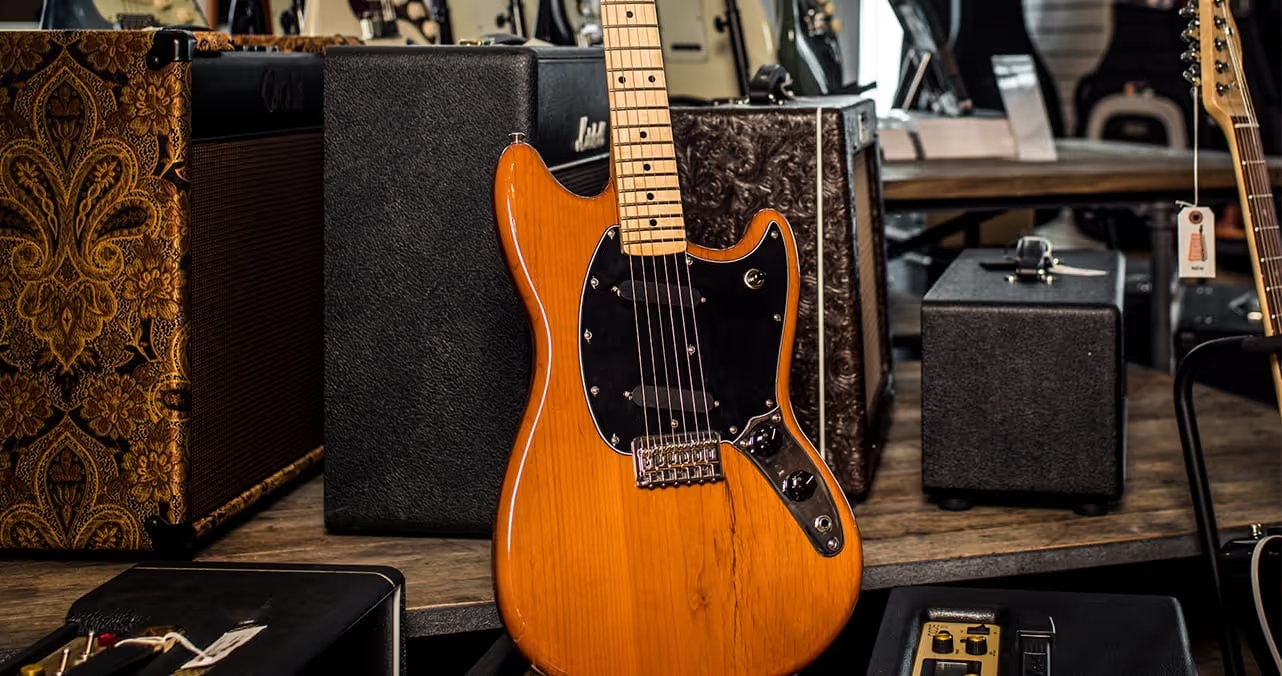
The unit currently listed is a Fender Player Series Mustang in Sienna Sunburst. Original gigbag, spec sheet, factory set-up paperwork. Our luthier has leveled the frets, set the trem float, and verified the pickup output. The instrument plays the way a Mustang should — slightly looser than a Strat, slightly punchier in the midrange, with the trem set so it returns to pitch reliably.
We don't claim it's a vintage piece. It's a current-production Mustang at a current-production price point.
Who this guitar is for
If you've owned a Strat for ten years and want a different feel without abandoning Fender ergonomics — the Mustang rewards the time. If you play in a downtuned register, the shorter scale handles drop tunings better than a 25.5-inch Fender. If you've been reading about offset guitars and don't know where to start, this is the cheapest way in.
If you primarily play heavy distortion through high-output pickups, the Mustang's voicing might disappoint. It isn't built for high-gain saturation. It's built for clean, jangly, slightly broken character. Choose accordingly.
The active draw
The Fender Mustang is currently featured in an active Great Guitar Giveaway draw. Entry mechanics, current pool size, and close date are listed on the draw page. No-purchase-necessary entry is available on every draw.